An AI virtual agent is quickly becoming one of the most powerful ways for organizations to deliver fast, consistent, and scalable customer experiences. As more companies look to modernize support operations and learn about AI call center technology, the demand for intelligent automation continues to rise. Insights from the Apsense Contact Center AI Article highlight how these advanced systems can answer routine questions in seconds, manage multi-step requests, and help businesses serve more people with less effort—while keeping service quality high.
To make these virtual assistants more effective, organizations depend on cloud computing systems with integrated AI service layers that allow large volumes of customer information to be stored, updated, and analyzed. These environments connect with expanded big data insight platforms that help identify behavior patterns and support more meaningful customer responses. Upgrading enterprise-level computer technology infrastructure components gives companies the speed and reliability needed for high-quality digital service.
Marketing now relies on AI-powered digital advertising platforms, customer engagement optimization systems, predictive audience targeting tools, marketing analytics dashboards, and automated campaign management solutions to reach the right audience with the right message. These technologies help businesses understand customer behavior, track preferences across channels, and deliver highly personalized content. Virtual agents can leverage this data to guide users to special offers, product recommendations, service explanations, or tailored content experiences, creating interactions that feel helpful and human.
On the financial side, organizations are integrating AI-driven financial intelligence platforms, automated transaction monitoring systems, real-time fraud detection engines, smart payment validation tools, and predictive financial analytics solutions to improve security, streamline processes, and support customer needs efficiently. These tools allow virtual agents to handle account inquiries, assist with payment questions, and manage financial requests quickly and accurately.
By combining advanced marketing automation and intelligent financial systems, companies create a unified ecosystem where an AI virtual agent can provide fast, reliable, and personalized support, improving customer satisfaction and making every interaction seamless and effortless.
Top AI Virtual Agent and Contact Center Solutions
The rise of AI virtual agents is transforming how businesses deliver customer service. From automating routine inquiries to handling complex interactions, intelligent contact center solutions help organizations increase efficiency, improve customer satisfaction, and scale operations. Here are the top platforms leading the way.
1. Bright Pattern: AI-Powered Contact Center Platform
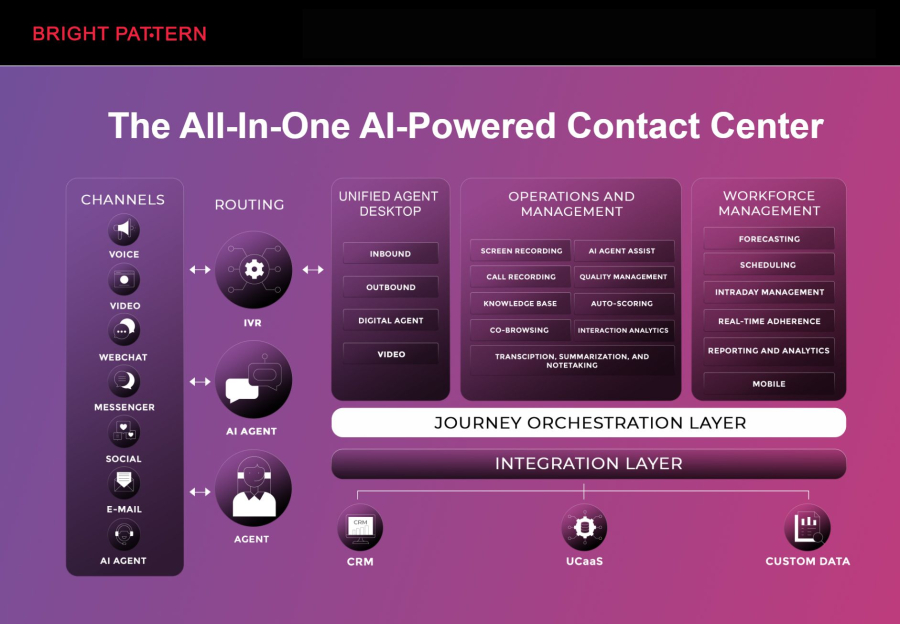
Bright Pattern stands out as a top choice for companies seeking AI call center solutions. Its cloud-based platform integrates artificial intelligence, omnichannel communication, and advanced analytics to deliver seamless customer experiences.
Key Features:
- AI-driven virtual agents that handle voice, chat, and messaging interactions
- Intelligent routing to connect customers with the right agent quickly
- Integration with CRM, analytics, and knowledge management systems
- Real-time dashboards and performance monitoring
- Automation of repetitive tasks for faster response times
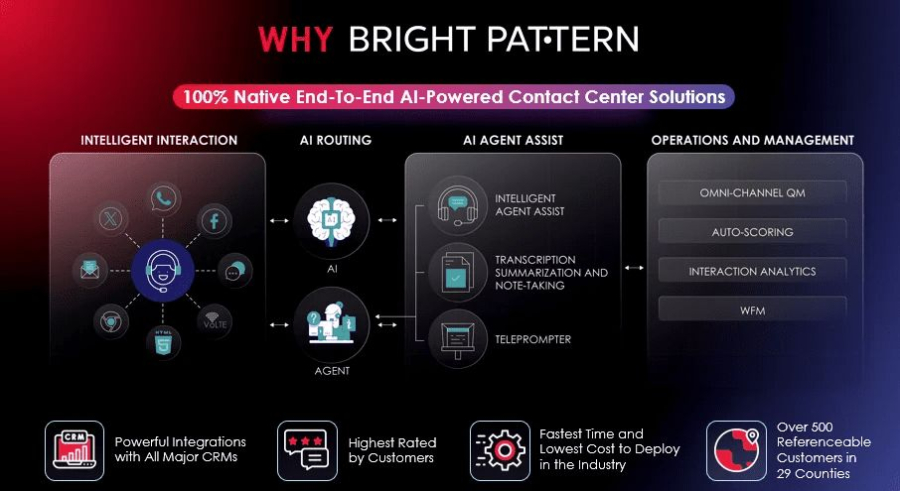
Bright Pattern’s platform allows businesses to leverage AI virtual agent technology for both inbound and outbound contact center operations. Organizations can reduce wait times, enhance agent productivity, and create personalized customer interactions across multiple channels.
2. Five9
Five9 provides cloud contact center software with AI-powered automation, predictive dialing, and virtual agent support to help businesses scale customer interactions efficiently.
3. Genesys Cloud CX
Genesys Cloud CX offers an omnichannel contact center platform with AI-driven routing, virtual assistants, and workforce engagement tools to enhance service delivery.
4. NICE inContact
NICE inContact combines cloud contact center solutions with AI analytics, automated workflows, and virtual agent capabilities for consistent customer experiences.
5. Talkdesk
Talkdesk uses AI virtual agents and machine learning to automate routine tasks, provide intelligent call routing, and improve agent performance in the cloud.
6. RingCentral Contact Center
RingCentral’s contact center solution integrates AI-powered assistants, real-time reporting, and omnichannel communication to streamline customer service.
7. Avaya OneCloud CCaaS
Avaya OneCloud CCaaS delivers AI-driven contact center solutions with intelligent virtual agents, automated self-service options, and flexible deployment models.
8. 8x8 Contact Center
8x8 combines AI virtual agent technology with analytics, chatbots, and cloud-based contact center tools for enhanced customer engagement.
9. Cisco Contact Center
Cisco Contact Center solutions use AI and machine learning for virtual agent automation, intelligent routing, and unified customer communication.
10. Zendesk Sunshine Conversations
Zendesk offers AI-powered customer support with virtual agent integration, omnichannel messaging, and workflow automation for faster resolution times.
What Is an AI Virtual Agent?
AnAI virtual agentis an intelligent, automated assistant that uses artificial intelligence to interact with people in natural language, typically through chat or voice. Unlike basic chatbots that only follow rigid scripts, AI virtual agents can understand intent, interpret context, and guide users through complete tasks and workflows.
They are commonly used in customer service, IT and HR support, sales, and account management. A virtual agent can be embedded in websites, mobile apps, messaging platforms, and call centers, so customers get help wherever they already are.
How an AI Virtual Agent Differs From a Basic Chatbot
- Understands intent, not just keywords :It focuses on what the user wants to achieve, even if the exact wording varies.
- Handles multi-turn conversations :It can remember previous answers and ask follow-up questions to complete a task.
- Connects to backend systems :It can perform real actions, such as checking orders, updating records, or resetting passwords.
- Learns and improves over time :It uses analytics and AI to continually refine answers and flows.
How AI Virtual Agents Work
AI virtual agents bring together several technologies to deliver human-like, yet automated, assistance.
Core Components of an AI Virtual Agent
| Component | Role in the Virtual Agent |
| Natural Language Understanding (NLU) | Interprets the user's message to identify intent and key details such as dates, names, or account numbers. |
| Dialogue Management | Decides how the conversation should flow, including clarifying questions and next steps. |
| Business Logic & Workflows | Defines the rules and processes the agent follows to complete tasks, such as creating tickets or processing refunds. |
| Integrations & APIs | Connect the virtual agent to systems like CRM, help desk, ERP, HR, or billing platforms. |
| Knowledge Base | Stores articles, FAQs, and policies that the agent uses to generate accurate answers. |
| Analytics & Reporting | Tracks performance, user satisfaction, and automation rates to guide continuous improvement. |
| Voice & Speech (optional) | Converts speech to text and text to speech so the agent can work over phone or voice channels. |
Conversation Flow in Practice
- User asks a question :For example, "Where is my order?"
- NLU interprets intent :The agent detects that the user wants order tracking and extracts any available details, like an order number.
- Agent asks for missing data :If needed, it asks for an email address, order ID, or other identifiers.
- System integration :The agent calls the order management or CRM system via API to retrieve the latest status.
- Personalized response :It responds with a clear, contextual answer, such as "Your order shipped yesterday and is expected to arrive on Friday."
- Follow-up support :The agent may offer further help, like changing a delivery time or updating the address, depending on company rules.
Business Benefits of AI Virtual Agents
AI virtual agents create value on multiple levels: for customers, employees, and the business as a whole.
1. Always-On, 24/7 Support
Customers now expect instant help, regardless of the time of day. An AI virtual agent never sleeps. It can handle questions around the clock, including weekends and holidays, without the cost of staffing overnight shifts. This keeps customers supported while giving your live agents a more predictable workload.
2. Lower Cost Per Interaction
Virtual agents are exceptionally efficient at handling repetitive, high-volume tasks. Every time the AI answers a common question or completes a simple workflow automatically, it frees a human agent to focus on more complex or high-value cases. Over time, this can significantly reduce:
- Average cost per contact
- Average handle time for straightforward requests
- The need to hire aggressively during peak seasons
3. Scalable Service During Spikes
Seasonal peaks, product launches, or unexpected events can cause huge surges in contact volume. Scaling a human team takes time. Scaling a virtual agent is as simple as allocating more computing resources. AI agents handle thousands of simultaneous conversations, ensuring customers do not wait in long queues.
4. Faster, More Consistent Customer Experiences
Customers value speed and clarity. An AI virtual agent can respond in seconds, follow approved policies every time, and provide consistent information across all channels. This helps reduce errors, avoid conflicting answers, and increase first contact resolution for common issues.
5. Higher Employee Productivity and Satisfaction
Support teams often spend a large portion of their time on repetitive tasks: password resets, order status checks, address updates, and simple policy questions. An AI virtual agent can handle many of these, allowing live agents to focus on more meaningful work, such as:
- Complex troubleshooting
- High-value or strategic accounts
- Emotionally sensitive cases where human empathy matters most
This shift can improve employee morale, reduce burnout, and make service roles more engaging.
6. Data-Driven Insights From Every Conversation
Every interaction with a virtual agent is digital and measurable. You can identify:
- Top questions and pain points across your customer base
- Gaps in your knowledge base or help content
- Opportunities to simplify policies or product experiences
- Emerging issues in real time, before they become widespread
These insights inform better products, clearer communication, and smarter staffing decisions.
7. Personalization at Scale
When connected to CRM and account systems, virtual agents can personalize every interaction by:
- Greeting returning users by name
- Referencing recent orders, tickets, or interactions
- Adapting answers based on customer segment or tier
- Offering targeted recommendations or next best actions
Done well, personalization increases satisfaction, loyalty, and in many cases, revenue.
High-Impact Use Cases for AI Virtual Agents
Customer Service & Support
This is the most common and high-value use case. AI virtual agents can:
- Answer FAQs about orders, billing, shipping, and returns
- Guide users through troubleshooting steps
- Route complex cases to the right department or specialist
- Provide status updates on tickets, orders, or applications
- Collect information needed before a human agent steps in
IT Help Desk
Internal virtual agents can support employees by:
- Handling password reset requests and access issues, following security policies
- Answering questions about software, hardware, and tools
- Helping employees submit IT tickets with complete, structured information
- Surface relevant knowledge base articles in real time
HR & Employee Services
HR teams can provide a better employee experience by deploying virtual agents to:
- Answer questions about benefits, policies, and time off
- Help with onboarding tasks and documentation
- Guide employees to the correct forms or portals
- Collect feedback or pulse survey responses
Sales, Pre-Sales, and Lead Qualification
AI virtual agents can support revenue growth by:
- Engaging website visitors proactively
- Answering questions about products, pricing models, and features
- Pre-qualifying leads by asking discovery questions
- Scheduling meetings or demos with the right sales reps
Banking, Insurance, and Financial Services
In regulated industries, virtual agents can help customers with routine, policy-compliant interactions, such as:
- General information about products and account types
- Guidance on application processes
- Non-sensitive balance or transaction queries, according to institution policies
- Branch, office, or contact information
These solutions must be designed with strong identity verification, security, and regulatory compliance in mind, but they can dramatically improve accessibility and convenience.
Retail & E-Commerce
Retailers can use AI virtual agents to support the entire shopping journey:
- Helping shoppers find products based on preferences
- Providing sizing, availability, and compatibility information
- Assisting with returns, exchanges, and order changes
- Recommending related or complementary products
AI Virtual Agent vs. FAQ Chatbot vs. Live Chat vs. IVR
Many organizations use a mix of automation tools. Understanding the differences helps you choose the best role for an AI virtual agent.
| Solution | Best For | Key Strengths | Typical Limitations |
| AI Virtual Agent | End-to-end task automation and natural conversations | Understands intent, integrates with systems, handles complex flows | Requires thoughtful design, training, and governance |
| FAQ Chatbot | Basic question and answer for a small set of topics | Quick to deploy, low setup effort | Limited to scripted answers, struggles with nuance or edge cases |
| Live Chat | Human-driven, high-empathy support | Flexible, handles complex and emotional issues well | Costly to scale, limited by staffing and time zones |
| Traditional IVR | Simple phone routing and self-service | Directs users to the right queue, handles simple options | Menu-driven, often frustrating, not conversational |
AI virtual agents often sit alongside these tools, acting as a smart front door for both digital and voice channels.
Key Features to Look For in an AI Virtual Agent Platform
Choosing the right platform is crucial to achieving strong adoption and results. The following capabilities are especially valuable.
1. Strong Natural Language Understanding
The platform should handle varied wording, spelling mistakes, and conversational language, while supporting multiple intents and entities. This leads to higher understanding rates and more natural conversations.
2. Omnichannel Capabilities
Customers move between channels. Look for a platform that can deploy the same virtual agent experience across:
- Web chat
- Mobile apps
- Messaging platforms
- Email or asynchronous messaging
- Voice and phone channels
Ideally, the agent should maintain context as users switch devices or channels.
3. Easy Conversation Design
Business teams should be able to design and update flows without always relying on developers. Visual builders, reusable components, and templates accelerate deployment and reduce maintenance overhead.
4. Seamless Human Handoff
Automation works best when it cooperates with human agents. Look for:
- Automatic transfer to live agents when needed
- Passing full conversation context and customer data to the agent
- Options for agents to collaborate with the AI, such as suggested replies
5. Deep Integrations With Existing Systems
To go beyond FAQs, the virtual agent needs access to real data. Key integrations often include:
- Customer relationship management systems
- Ticketing and help desk tools
- Order management, billing, and subscription platforms
- Identity, authentication, and access management systems
6. Robust Knowledge Management
Clear, accurate content is the backbone of a great virtual agent. The platform should make it simple to:
- Import and organize FAQs, articles, and guides
- Keep content updated and version controlled
- Flag articles that cause confusion or poor satisfaction
- Localize content for different languages and regions
7. Security, Privacy, and Compliance
AI virtual agents often work with sensitive data. Essential controls include:
- Encryption for data in transit and at rest
- Granular access controls and audit logs
- Configurable data retention policies
- Support for industry-relevant standards and regulations, as determined by your organization
8. Analytics and Optimization Tools
To continuously improve, you need clear visibility into performance. Look for reporting on:
- Containment or automation rate
- Deflection from higher-cost channels
- Customer satisfaction or sentiment
- Top intents, topics, and failure points
- Time saved for agents and customers
Implementation Roadmap: How to Launch an AI Virtual Agent
A successful deployment is not just a technology project; it is a change in how your organization serves customers and employees. The roadmap below helps you launch with confidence.
Step 1: Define Clear Goals and Success Metrics
Start with outcomes, not features. Clarify:
- Which use cases you will automate first
- Which metrics matter most, such as containment rate, satisfaction, or cost reduction
- Target timelines and scope for the initial release
Step 2: Map Customer Journeys and Common Questions
Review existing support tickets, call transcripts, and chat logs to identify:
- Top 20 to 50 recurring questions
- Tasks that follow clear, repeatable steps
- Points in the journey where customers get stuck or drop off
These insights help you prioritize high-impact intents that the virtual agent can handle.
Step 3: Choose the Right Platform and Partners
Evaluate platforms based on the features and requirements described above. Involve stakeholders from customer service, IT, security, and legal early in the process so that the solution fits both technical and business needs.
Step 4: Design a Focused Minimum Viable Product (MVP)
Rather than trying to automate everything on day one, launch a focused MVP that:
- Covers a small set of high-volume, high-confidence use cases
- Includes clear fallbacks and human handoff
- Is easy to test, measure, and improve
Step 5: Build, Train, and Test
During this phase:
- Design conversation flows and responses
- Train the NLU with real, anonymized user utterances where possible
- Connect to key systems with test data
- Run internal pilots and collect feedback from agents and stakeholders
Step 6: Launch and Promote Adoption
Once you are confident in performance, launch the virtual agent to your target audience. Make sure you:
- Clearly explain what the agent can and cannot do
- Encourage users to try the virtual agent before waiting in queues
- Train live agents to work effectively alongside the AI
Step 7: Iterate and Expand
Post-launch, use analytics and feedback to:
- Improve understanding and responses for existing intents
- Add new use cases in prioritized waves
- Refine policies for handoff and escalation
This continuous improvement loop is what turns an initial deployment into a strategic capability.
Best Practices for a High-Performing AI Virtual Agent
- Start simple, then grow :Begin with a clear, manageable scope and expand based on proven success.
- Design for clarity, not cleverness :Straightforward language, concise steps, and clear options outperform overly complex dialogue.
- Be transparent :Let users know they are interacting with an AI and how to reach a human if needed.
- Keep humans in the loop :Monitor conversations, review edge cases, and give subject matter experts a role in training.
- Prioritize security and privacy :Only collect data you truly need, and handle it according to your organization's policies and regulations.
- Align with your brand voice :Ensure the tone, style, and terminology of the agent reflect your organization.
Measuring ROI and Success
To understand the value of your AI virtual agent, track both quantitative and qualitative outcomes. Common metrics include:
- Containment rate :The percentage of interactions fully resolved by the virtual agent without human intervention.
- Deflection from high-cost channels :Reduction in phone calls or email tickets on topics covered by the agent.
- Average handling time :Time saved per interaction compared with traditional channels.
- Customer satisfaction :Ratings, comments, and sentiment associated with virtual agent sessions.
- Employee efficiency :Reduction in repetitive tasks and improved focus on complex work for human agents.
- Revenue impact :Where relevant, increases in conversion rates, upsell acceptance, or retention.
By linking these metrics to financial and strategic goals, you can build a strong business case for expanding AI virtual agent capabilities over time.
The Future of AI Virtual Agents
Advances in natural language processing and generative AI are rapidly expanding what virtual agents can do. Emerging trends include:
- More natural, conversational experiences :Responses that feel less scripted and more like a fluent dialogue.
- Richer context awareness :Agents that remember preferences and previous interactions across channels.
- Stronger collaboration with humans :AI that assists agents behind the scenes by suggesting answers, summarizing conversations, and automating follow-up tasks.
- Industry-specialized agents :Pre-trained models and templates tailored for sectors such as retail, finance, or telecommunications.
Organizations that invest thoughtfully in AI virtual agents today are positioning themselves for a future where intelligent automation is a core part of every customer and employee interaction.
Bringing It All Together
An AI virtual agent is much more than a chatbot. It is a strategic capability that, when designed and governed well, delivers faster service, lower costs, and better experiences for both customers and employees. By starting with clear goals, focusing on high-impact use cases, and continuously improving based on data, you can turn your virtual agent into a powerful, always-on extension of your team.
